
Context
The portfolio's first hardware work. Every other entry ships bits to a screen. This one ships atoms: sensors, a pump, a grow light, and a robot that watches a plant and decides what it needs. It is the clearest signal that the practice builds physical things with AI in the loop, end to end, from a soil reading to a watering decision to a relay that clicks. The point of the project was to take an AI reasoning loop out of the browser and put it in front of a living thing, where the cost of a wrong call is real.
v1 · STATIONARY · BUILT
A small stationary plant-care system, built and run. A Raspberry Pi 5 served as the brain. A capacitive soil-moisture sensor and a BH1750 light sensor fed it readings. A Pi Camera watched the plant. A water pump sat on a relay, and a smart grow light ran through Tasmota. An Arduino UNO R4 WiFi handled the sensor node, leaving the Pi free for the thinking.
A Flask API tied it together, with real endpoints: /status, /water, /logs,
and /clear_logs. The system logged readings over time, watered when moisture
dropped below a threshold, and ran the lights on a schedule.
The interesting layer sat on top. An LLM read the plant photos, judged plant health, and decided what to do. It did not just act. It explained each care decision in plain language, so the reasoning behind a watering was legible, not buried in a threshold.
The experiment · raising a radish
The clearest proof that v1 ran is a radish that it grew. The rig was handed a seed and left to raise it, posting a daily first-person journal driven by real telemetry.
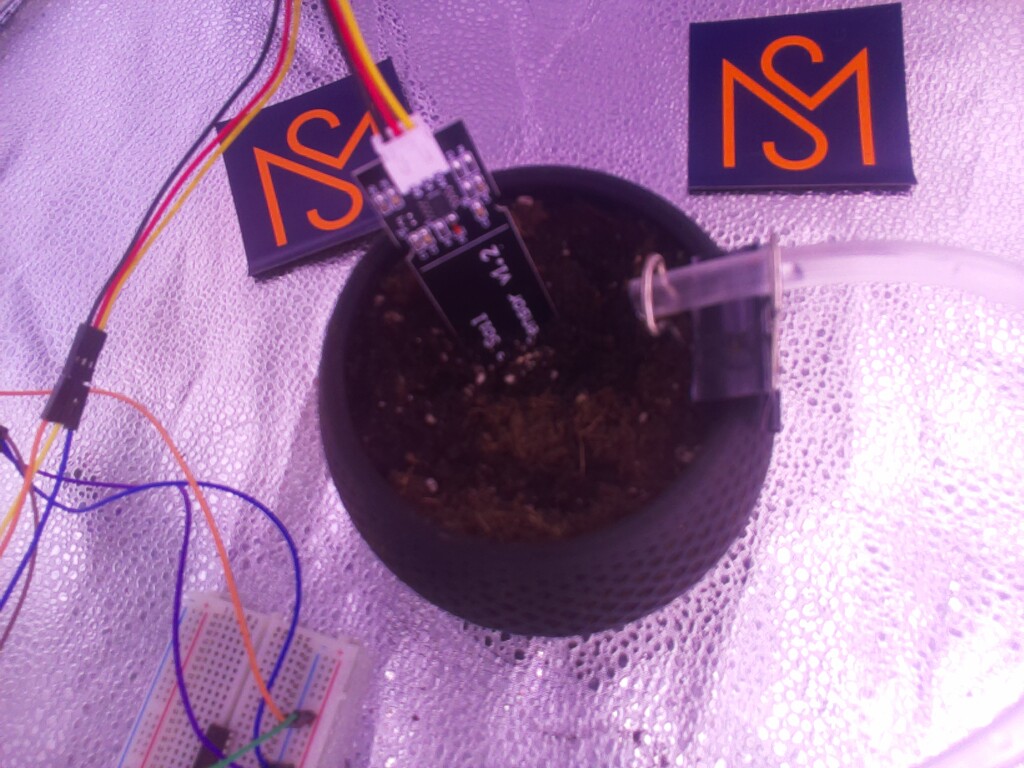
Three frames mark the journey. Day one is a pot of soil, a sensor probe, and an irrigation tube, no plant in sight, the bot writing encouragement down to a seed it cannot see. Day three is a single pale sprout breaking the surface. Day seven is a full leafy seedling under the purple wash of the grow light. The journal runs alongside, each entry stamped with the day's moisture, growth, health score, and the plant's reported mood.
- Day 1 / 24
- germination
- Health
- —
- Moisture
- 87%
- Growth
- +0mm
- Mood
- hopeful
- Pump
- idle
Still no visible sign of my little sprout, and no pump activations at all.
Move across the days and watch the readings, the photo, and the entry change together. It is the rare hardware claim a visitor can read rather than take on faith. The seed went in, the machine kept it alive, and it told you how it felt the whole way.
v2 · GANTRY · IN SPEC
Designed, not built. The successor is a gantry FarmBot, a desktop-scale clone of the commercial system: a 2 ft by 4 ft autonomous robot that moves across a raised bed on rails. The plan keeps the Pi 5 as the brain and adds an Arduino for motor control, computer vision and plant identification, and precision watering at a coordinate rather than a pot. Many of the parts may be laser-cut in house. The ambition is grounded in a working maker toolkit, not in a finished machine. It exists as drawings and a stack, waiting to be made.
What was learned
Moving an AI loop into the physical world changes the stakes. Sensors drift, so a reading is a guess, not a fact. Water is irreversible. You cannot un-water a plant the way you can undo a database write. A wrong decision has a physical cost, paid by something alive. The discipline is not smarter prompts. It is knowing when the model should act and when it should wait.
Toolkit
PI 5 · AI HAT · PI CAMERA · GLOWFORGE · BAMBU A1